

A logo that looks sharp on a white screen can disappear into cork’s grain. A bright printed panel can stand out beautifully but feel different under the palm. On a yoga mat, branding is part of the contact surface, so the decoration method affects both appearance and use.
For a custom cork yoga mat logo, the best starting point is simple: choose laser engraving for understated, ink-free branding; heat transfer for compatible full-color artwork; and UV printing for fine detail, strong contrast, and white ink. The final choice depends on your artwork, cork finish, print area, and budget.
Compare the Three Methods
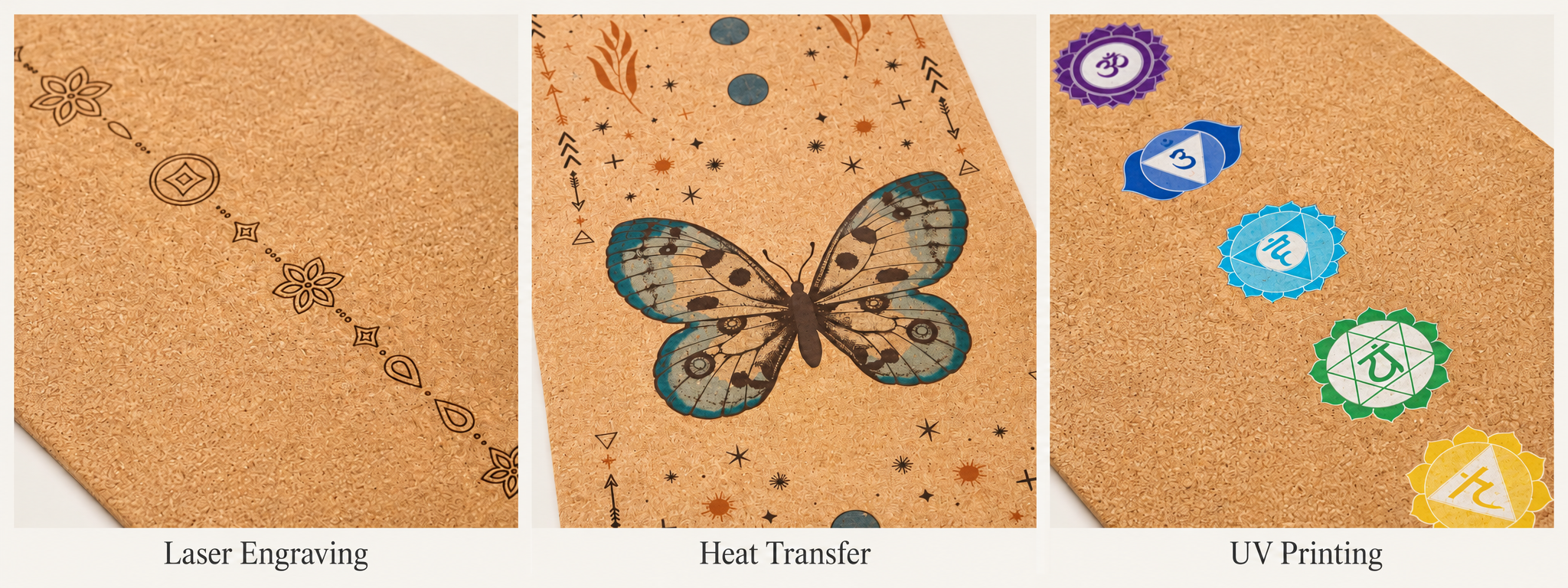
These cost levels are planning guides for comparable small logos, not fixed quotations. Large designs, additional layers, and production volume can change the ranking.
| Method | Visual style | Touch and feel | Durability | Eco-friendliness | Cost level | Best use case |
|---|---|---|---|---|---|---|
| Laser engraving | Brown, tonal, understated | Integrated into cork; may feel lightly recessed | No ink film to peel; cork itself can still wear | No marking ink or transfer carrier; energy and extraction still required | Low–medium for small marks; rises with engraving time | Minimalist premium brands, monograms, alignment lines |
| Heat transfer | Multicolor graphics and gradients; appearance depends on transfer system | Can be smooth and low-profile; some transfers leave a noticeable film | Depends on adhesion, flexibility, and heat application | Depends on inks, adhesives, and disposable carriers | Medium; repeat runs can spread preparation costs | Colorful logos, illustrations, mid-range collections |
| UV printing | Crisp detail, vivid graphics, optional opaque white | Surface ink can be felt, especially with layered printing | Depends on ink flexibility, adhesion, and curing | UV-curable does not automatically mean water-based or environmentally preferable | Medium–high when white or multiple layers are needed | White logos, intricate graphics, strong visual contrast |
Laser Engraving: The Premium Minimalist Choice
How it works and looks
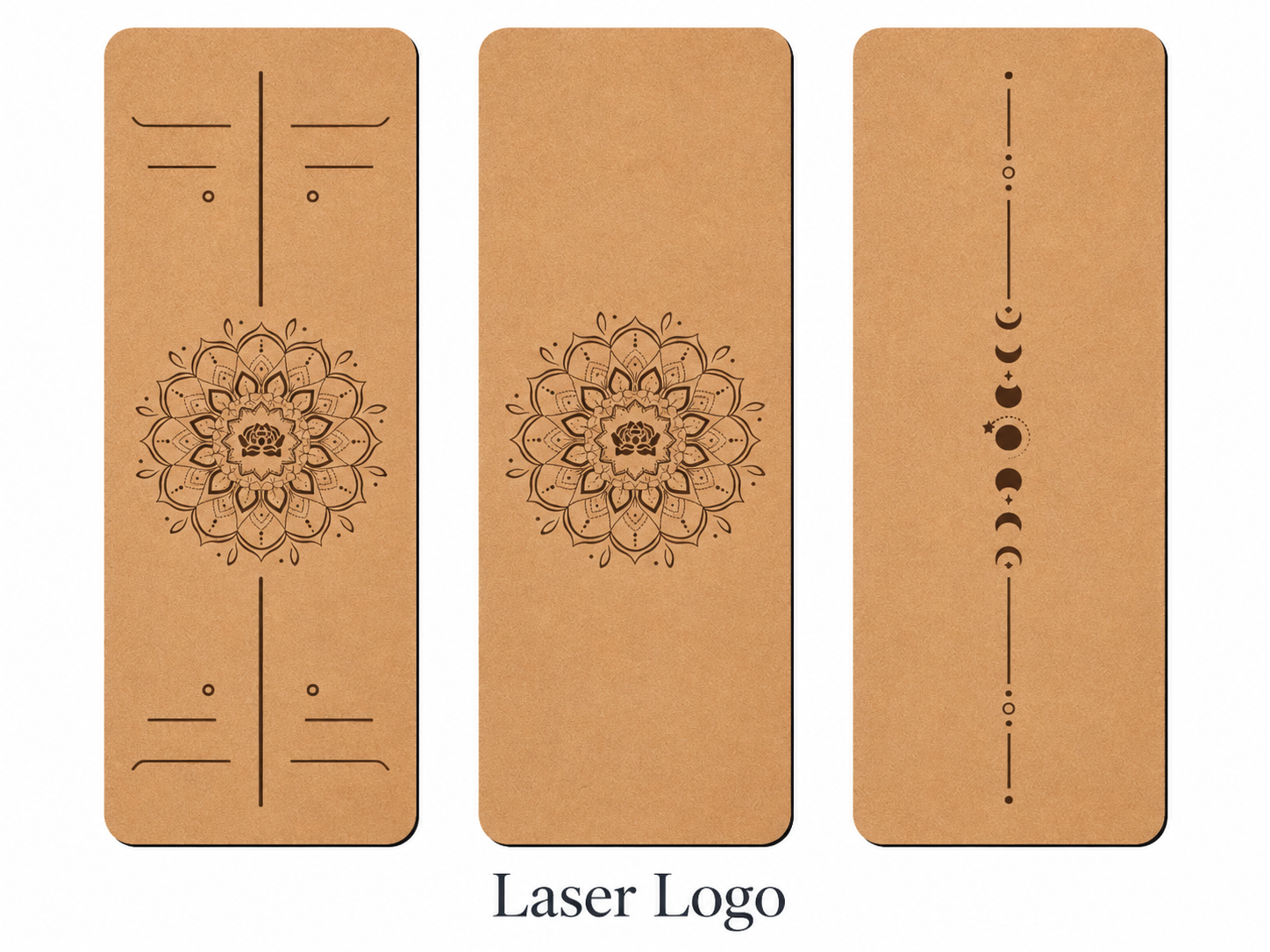
A laser applies controlled heat to the cork, darkening and sometimes removing a small amount of the surface. The resulting mark is usually brown, with contrast influenced by cork grain and machine settings. It does not add a colored ink layer.
Touch and durability
Light engraving can preserve much of the cork’s original feel, with a subtle recessed texture. Deeper engraving creates a more pronounced mark, but depth should serve legibility rather than become a feature that catches under the hands.
Because the image is formed in the material, there is no printed film to lift or peel. However, “engraved” does not mean immune to wear: abrasion can gradually change the cork surface and reduce contrast. The practical advantage is avoiding an added ink layer, not a promise that the mark will remain unchanged forever.
Cost and best applications
For a compact logo, laser can be economical because it needs no printing plate or transfer sheet. A large filled design requires more machine time, so engraving an entire mat may cost substantially more than adding a small corner mark.
Choose laser for minimalist logos, short text, and alignment guides. Simple shapes usually remain clearer against natural grain than tiny lettering or densely shaded artwork. For premium private label yoga mat branding, this is often the most convincing way to let the cork remain the main visual feature.
Heat Transfer: The Colorful Illustration Option
How it works
For a heat transfer cork mat, the process uses heat and pressure to move an image from a carrier onto a compatible surface. The exact system matters: transfer films, adhesives, and sublimation-based processes do not behave identically. Untreated cork should not be assumed suitable for any standard textile transfer.
Visual effect and feel
Compatible full-color systems can reproduce CMYK artwork, gradients, and illustrations. This makes heat transfer attractive for lifestyle collections where the artwork is more important than an understated natural finish.
Without an opaque white base, cork’s brown tone can make colors look warmer, darker, or less saturated than the same artwork printed over white. UV printing with a white underlayer may look brighter, but heat transfer is not automatically darker in every configuration.
A thin transfer can feel smooth and unobtrusive. Other systems leave a more noticeable layer or edge. For a large graphic, compare the decorated area with the surrounding cork by hand; appearance alone will not reveal whether the finish suits your collection.
Durability and commercial fit
Transfer durability depends on adhesion, application settings, and flexibility during rolling. Poorly matched transfers can lift at the edges or crack. A good initial print should also survive the cleaning and handling expected for the product.
Heat transfer suits colorful logos and illustrated mid-range collections when the chosen process delivers the right finish at the intended quantity. Ask for setup and per-unit costs separately: repeating one approved design can distribute preparation costs more effectively than ordering several small artwork batches.
UV Printing: Detail, White Ink, and Strong Contrast
How it works
UV printing jets ink directly onto the surface and cures it using ultraviolet light. Compatible equipment can print color and white, allowing a white logo or a white underlayer beneath colored artwork.
Visual precision and surface feel
White ink is particularly useful on darker cork, where pale colors may otherwise lose definition. It can also support more consistent-looking color by reducing the visible influence of the brown background.
UV printing can reproduce intricate artwork, although the cork grain still limits how cleanly very small details appear.
The cured ink sits on the surface. White underlayers or repeated passes can make a design more noticeable to the touch. A small logo may be unobtrusive, while a large solid panel can create a clear difference in feel.
Durability, setup, and cost
A yoga mat bends and rolls, so ink flexibility matters alongside adhesion. An ink intended for a rigid sign is not automatically suitable for a flexible mat. Poor matching or incomplete curing can contribute to cracking, scratching, or loss of adhesion.
Direct digital printing can simplify artwork changes because it does not require a separate transfer carrier. That can benefit short design runs, but white ink, extra passes, pretreatment, and handling increase cost. Choose UV when those additions deliver something your brand needs, especially opaque white or intricate color graphics.
Laser Engraving vs. UV Printing: Which Fits Your Yoga Mat Brand?
For a minimalist premium collection, start with laser. It keeps the material visually prominent and avoids a separate printed layer. Reserve enough space around the logo for the grain to remain part of the design.
For a colorful lifestyle collection, compare heat transfer and UV using the same artwork. Select heat transfer when its color, feel, and repeat-order economics meet the brief. Select UV when white ink or greater contrast makes a meaningful difference.
For alignment guides plus a colored logo, consider a hybrid. Laser lines can provide a restrained layout, while a printed mark carries the brand color. The additional process raises cost and requires accurate positioning between operations.
MOQ is a separate question from print capability. A digital machine may produce one sample, while a custom mat construction or packaging order requires a larger batch. Request the minimum quantity per construction, artwork, and colorway from your OEM yoga mat factory.
Design Files and Placement: Get These Right First
Keep laser artwork clean
Use clear outlines, readable lettering, and open spacing. Dense shading and fine decorative strokes can merge with the cork pattern. Review the design at its actual finished size rather than approving an enlarged screen preview.
Supply production-ready files
For logos and laser paths, provide editable vector artwork such as AI, SVG, or a vector PDF, with fonts converted to outlines. Include the final width, height, and distance from the mat edges.
For photographs or illustrations, supply high-resolution artwork at the intended print size; around 300 ppi is a useful starting point. Include brand color references and identify any areas requiring white ink. The printer should confirm its preferred color profile and file setup. Markdown files are suitable for written instructions, not production artwork.
Choose placement around use
A small corner or end-position logo preserves an uninterrupted practice area. A centered logo creates stronger visibility when the mat is photographed or displayed, but it may sit beneath hands or feet during some movements.
For large graphics, check dry and damp traction across both printed and unprinted areas. Alignment lines also need clear positioning relative to the final mat dimensions, especially on wider or custom-shaped designs.
Factory Insider Tip: Approve the Finished Surface
The most useful approval sample uses the actual cork grade, backing, decoration method, and final artwork size. A print on a separate flat board cannot establish how a finished mat will feel or behave when rolled.
For a Luna cork mat project, physical sample approval provides the reference before custom bulk production. Build the branding review around visible detail, touch, position, and the expected cleaning routine. Where durability is critical, agree on the evaluation method and acceptance criteria before ordering.
Ink descriptions deserve the same attention. “Water-based,” “UV-cured,” and “non-toxic” are not interchangeable. Request documentation for the specific ink system and relevant finished-product requirements instead of treating a general environmental label as proof of suitability.
Frequently Asked Questions
Will the logo peel off?
Laser engraving has no added ink film to peel, although the cork can wear. Heat transfer and UV printing depend on adhesion and process compatibility. Inspect printed samples after rolling and cleaning, paying particular attention to edges and densely printed areas.
Which method is the most eco-friendly?
Laser avoids marking ink and disposable transfer carriers, making it a strong candidate when minimizing added materials is the priority. That does not establish the lowest overall environmental impact in every case; energy use, processing waste, and the full mat construction also matter.
Can I combine laser alignment lines with a printed logo?
Yes. This hybrid approach combines subtle guides with a colored or white brand mark. It costs more because it adds another production step, plus positioning and inspection between processes. Request a combined sample to approve the complete result.
Send Your Logo for a Free Method Recommendation
Not sure which method fits your design? Send Luna Yoga Group your logo file, preferred placement, mat specifications, and estimated quantity. Our engineers will recommend the best printing method for your project free of charge.
You can also explore our cork yoga mat options before selecting the backing and branding combination.
Talk directly to Luna Yoga
Bring Your Cork Mat Branding to Life
Contact our team for samples, a branding method recommendation or a factory quotation. Include your logo, preferred backing, dimensions and estimated order quantity.
Both buttons take you to our contact page. Send your requirements to our team.
Samples are free; shipping costs are paid by the customer. Sample preparation and delivery arrangements are confirmed for your request.